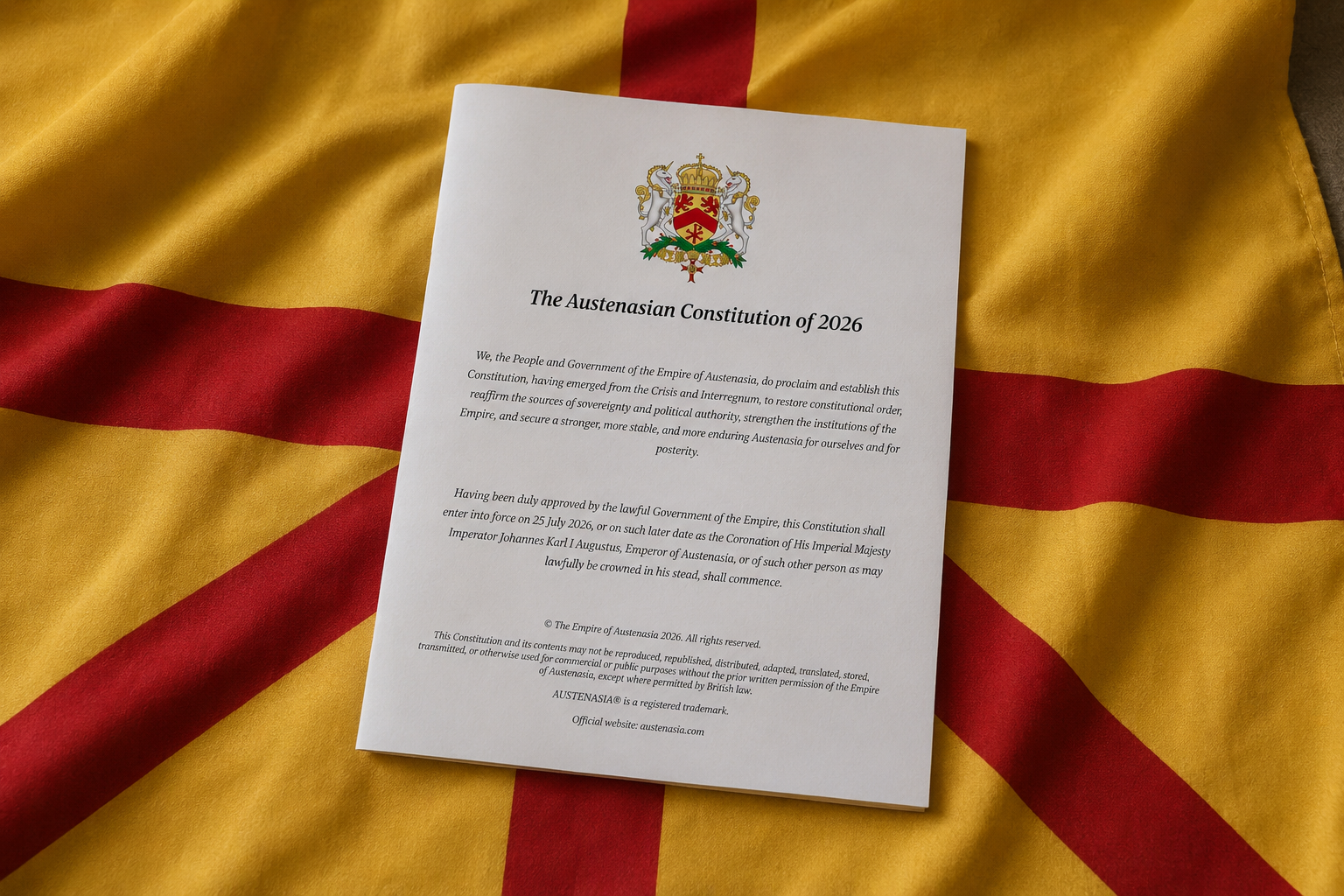
Tomorrow, coinciding with the Coronation of His Imperial Majesty Johannes Karl I Augustus, the Empire of Austenasia proposes to replace its 2011 Constitution with an entirely new constitutional framework. The proposed Constitution is not simply an amendment. It is a complete rewrite intended to reflect the constitutional developments of the past fifteen years, particularly the Crisis and Interregnum.
Constitutional Supremacy
The opening chapter establishes the Constitution as the supreme law of the Empire. Any law, decree or agreement inconsistent with it would automatically be void. Unlike previous constitutional arrangements, the document also provides guidance on how constitutional disputes should be resolved, emphasising agreement between the Empire’s institutions wherever possible
Recognising the Crisis and Interregnum
One of the Constitution’s principal purposes is to provide legal certainty regarding the events of 2024–2026.
It formally:
- repeals the 2011 Constitution;
- recognises the Interregnum as a lawful constitutional period;
- confirms that the Government exercising authority during that period remained the lawful Government of the Empire; and
- validates every decision, appointment, honour and law made during that time.
The Constitution also establishes an official constitutional narrative of the Crisis, recognising only one lawful line of succession and one lawful Government.
Protecting the Empire’s Identity
Several provisions are aimed at protecting Austenasia’s legal identity.
The Constitution states that:
- only one lawful Empire of Austenasia exists;
- rival or successor organisations cannot claim constitutional legitimacy;
- constitutional recognition cannot be given to splinter governments; and
- ownership of trademarks, copyrights, domains and other intellectual property is unaffected by constitutional change.
These provisions seek to separate constitutional legitimacy from ownership of private property and intellectual property rights.
Defining the Empire
The Constitution confirms that:
- the Empire continues under the name “Empire of Austenasia”;
- the Commonwealth period did not create a new state;
- Austenasia claims continuous existence from 20 September 2008;
- Wrythe remains the symbolic capital; and
- the Empire possesses its own legal personality separate from the Crown or Government.
It also reorganises territorial administration into six regional jurisdictions while confirming that Antarctica and Bir Tawil will not be claimed.
Subjectship
The Constitution modernises Austenasian nationality law.
Subjectship becomes entirely voluntary, requiring application through official procedures and approval by the Crown following review by the Home Secretary.
Importantly, becoming an Austenasian subject does not confer citizenship, passports or immigration rights under any recognised sovereign state. The Constitution also makes clear that Austenasian law cannot require subjects to break the laws of the countries in which they live.
The Crown
The monarchy undergoes significant constitutional reform.
Among the most notable changes are:
- executive authority is vested in the Crown;
- hereditary succession is abolished;
- family membership alone provides no claim to the Throne;
- the Founder is recognised as presiding over coronations while able to do so;
- the Monarch and heir are required to remain politically impartial.
The Crown therefore becomes a constitutional institution rather than a hereditary possession.
A New System of Succession
Perhaps the largest constitutional change is succession.
Rather than inheriting the Throne, each Monarch nominates a preferred heir. The Senate then confirms that nomination by majority vote.
If no nomination is made, the Senate elects the next heir itself.
The heir assumes the historic Roman title Caesar (or Caesarissa) and becomes Crown Prince or Crown Princess.
The Senate also gains powers to remove an heir in certain circumstances, meaning succession remains constitutional rather than hereditary.
Regency
The Constitution creates detailed procedures for situations where the Monarch cannot exercise the duties of the Crown.
Normally, the elected heir serves as Regent. If there is no heir, the Prime Minister becomes Lord Protector and Regent, exercising the powers of the Crown without becoming Monarch.
Powers of the Crown
The Monarch’s legislative role is clearly defined.
Bills require Imperial Assent before becoming law. However, where the Monarch has a genuine moral or religious objection, the Constitution allows that decision to be delegated to the heir.
The Crown may also return legislation with constitutional objections rather than simply approving or rejecting it outright.
Reforming the Senate
The House of Representatives is replaced constitutionally by the Senate.
Representation is reorganised through:
- Regional Senators;
- Territorial Senators;
- Governors automatically holding one Senate seat; and
- elected Territorial Senators representing individual territories.
Britannia Austenasiana receives additional representation in recognition of its historic role as the Empire’s founding region.
Government
The Constitution formalises the executive Government.
Among its provisions:
- Prime Ministers and Deputy Prime Ministers serve fixed five-year terms;
- elections occur on fixed dates;
- Deputy Prime Ministers automatically succeed a Prime Minister who has resigned, died or been removed;
- the Senate may pass motions of no confidence; and
- the Crown retains limited constitutional safeguards where a dismissal would itself undermine the Constitution.
These provisions are intended to provide both democratic accountability and constitutional stability.
Bill of Rights
The Constitution introduces a dedicated Bill of Rights.
Among the rights protected are:
- equality regardless of race, sex, sexual orientation, gender identity or disability;
- freedom of opinion and expression;
- recognition of marriages lawfully entered into under recognised jurisdictions.
The Constitution also makes clear that these rights exist alongside, rather than replacing, rights provided under recognised sovereign states
Constitutional Amendment
Finally, the Constitution establishes its own amendment process.
For six months following commencement, almost every provision may still be amended while practical experience is gained. After that transition period, a number of core constitutional principles, including constitutional supremacy, recognition of the lawful Government during the Crisis, the lawful line of Monarchs, key property protections, the Empire’s continuity, and fixed election terms, become permanently entrenched.
Future amendments would require:
- a two-thirds majority of the Senate;
- approval by referendum; and
- Imperial Assent.
This makes the Constitution significantly more difficult to amend than its predecessor while preserving a democratic mechanism for constitutional change.
Conclusion
The proposed 2026 Constitution is the most extensive constitutional reform in Austenasian history. Rather than simply updating the 2011 Constitution, it seeks to codify the constitutional lessons of the Crisis and Interregnum, clarify the powers of the Crown and Government, modernise succession, establish a comprehensive Bill of Rights, and create a more stable framework for the Empire’s future. When adopted, it will become the supreme law of the Empire upon the commencement of the Coronation tomorrow.